Cutting Patterns in Dressmaker
Grain versus bias, the green outline rule, Tetris packing, and leftover bolts.
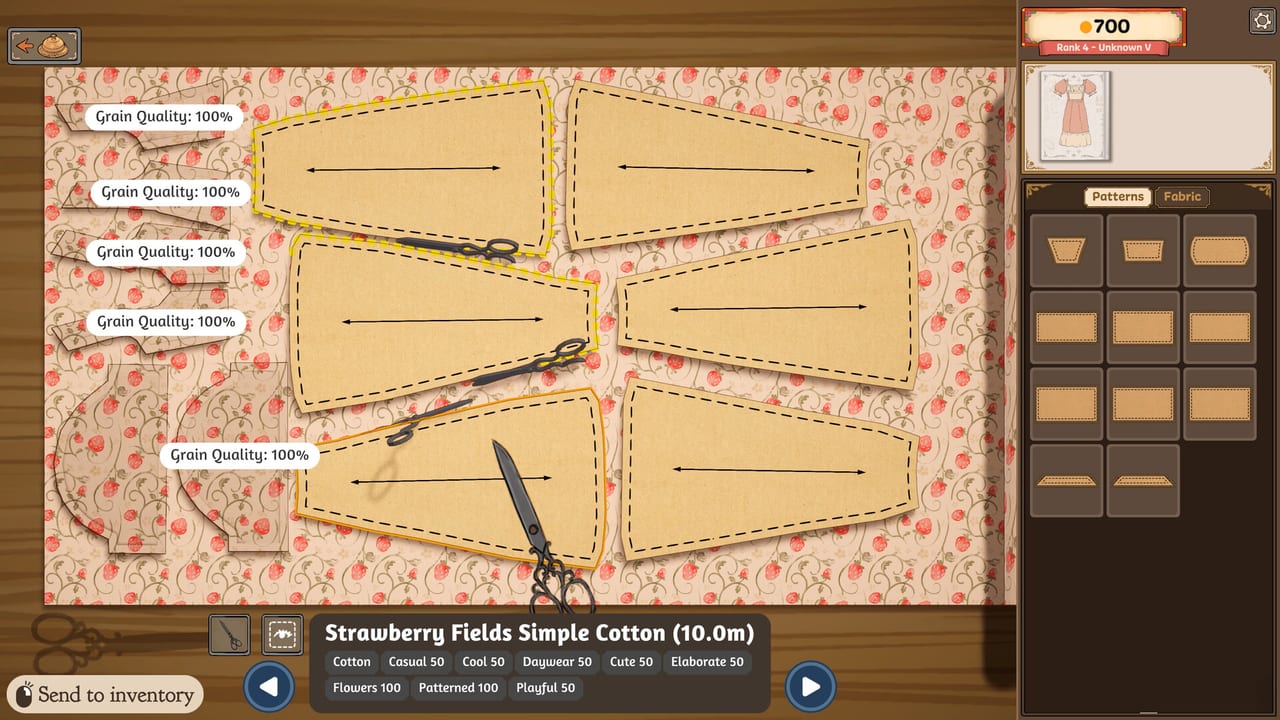
The cutting table is where Dressmaker stops being a dress-up menu and starts being a craft sim. Pattern pieces are physical shapes you lay on a bolt. How you rotate them, how you pack them, and whether you respect grain decides the ceiling for everything that happens on the sewing machine. If you only remember one sentence from this page, remember this: grain misalignment caps quality even if sewing is perfect.
Read this after How to Play so you know why you are at the table. Read How to Sew next, not before. A beautiful stitch on a crooked grain is still a capped dress.
Grain, bias, and the green outline
Each piece shows a grain-line arrow. That arrow is the direction of the fabric’s threads. Rotate the piece until the arrow sits horizontal — left/right, not up/down. When the rotation is correct, the outline turns green. No green, no go.
Beginners treat any straight edge as “aligned.” Lengthwise grain and cross grain are not the same as a random 90-degree parking job that still points the arrow at the ceiling. Watch the arrow, not your sense of tidiness. If the outline stays uncoloured, the table is telling you the grain is wrong.
Bias is the 45-degree diagonal. In real dressmaking, bias gives drape and stretch. In Dressmaker it is a valid advanced choice, not a fail state. Use it when you want a piece to hang differently and you understand you are leaving the beginner green-horizontal rule on purpose. Do not call a mistake “bias” after the fact. If you did not choose it, recut.
Packing pieces like Tetris
Bolts are rectangles. Pieces are awkward. Nest them the way you would nest cookies on a tray: long edges together, small collar pieces in the gaps, mirrored pairs flipped to share a straight. The goal is not a pretty layout screenshot. The goal is leftover cloth you can still name as a future sleeve.
Waste is coin. A 300-coin professional brief dies if you buy a second bolt because the first was Swiss-cheesed by sloppy placement. A ball brief with a 1000-coin example budget still notices if silk offcuts could have been another panel. Pack first, cut second.
If a piece will not fit, rotate in 90-degree grain-legal steps before you buy more metres. Horizontal arrow, green outline, then consider a new bolt. The fabric ranking helps you decide whether that new bolt should even be the same fibre.
Leftover bolts and recuts
After scissors, remaining length stays in the shop. That leftover is inventory. Use it for facings, cuffs, smaller skirts, or the next modest commission. Do not auto-buy full metres because the shop UI is pretty.
Recut when the grain is wrong, when a piece overlaps the bolt edge, or when you realise the silhouette in the sketchbook does not match the brief. Recutting cloth is cheaper than sewing a doomed seam. The prototype has shown a save-reload quirk that restored metres; do not plan around it. The team has said the full game does not refill fabric on reload.
If you cut the wrong fibre entirely — velvet on a library job, cotton on a velvet-or-silk night — the recut cannot fix taste. That is a customer and sketchbook problem. Come back to the table only after the sample pins match occasion and budget.
How cutting feeds the score
Delivery reads quality, style, and budget. Cutting owns the quality ceiling and part of the budget through waste. Sewing owns the live stitch number. You cannot sew your way out of a red (or un-green) outline. Run this order when a dress disappoints: outline colour, leftover waste, stitch line, then style tags. The quality checklist is the short form of that audit.
Practise on cotton. Pattern pieces are easier to see, mistakes are cheap, and professional early clients actually want it. Save bias experiments and striped matching for a bolt you can afford to spoil. When Steam’s larger catalogue arrives on 21 September 2026 — 450+ fabrics, lace and sequins in the full shop — the same green-outline rule still applies. More prints do not relax grain. They make misalignment more visible.
Cut like a stingy tailor who likes the cat and wants the newspaper to print a competent shop, not a dramatic disaster. Then walk to the machine.
Frequently Asked Questions
Quick answers for launch week, the prototype, and the sewing loop.
What does a green outline mean on the cutting table?
The grain-line arrow is horizontal and the piece is on grain. Cut only then, unless you are deliberately choosing bias. Wrong grain caps quality later.
Is bias always a mistake?
No. Bias is a valid advanced choice for drape. It is not the default. If the arrow is vertical by accident, recut rather than renaming the error.
Why did a perfect sew still score badly?
Grain misalignment caps quality even if the stitch is clean. Confirm outlines in this guide, then use the quality checklist and How to Sew.
Should I buy extra fabric for every dress?
Buy to the pattern, pack tightly, and recut leftovers. Extra metres are for a planned second colour or a known tricky layout, not for panic. See the fabric ranking before you upgrade fibre.
Can I recut after sewing starts?
Recut before you commit a bad piece to the machine. Sewing a known grain fault wastes time. Station order is in How to Play.
Do leftovers carry between commissions?
Yes in the shop inventory. Use offcuts on the next modest job. Do not rely on prototype reload tricks; the full game is not designed to refill bolts when you save.